NadmaaTechnologies

Business portals

Give customers answers without adding work for your team.

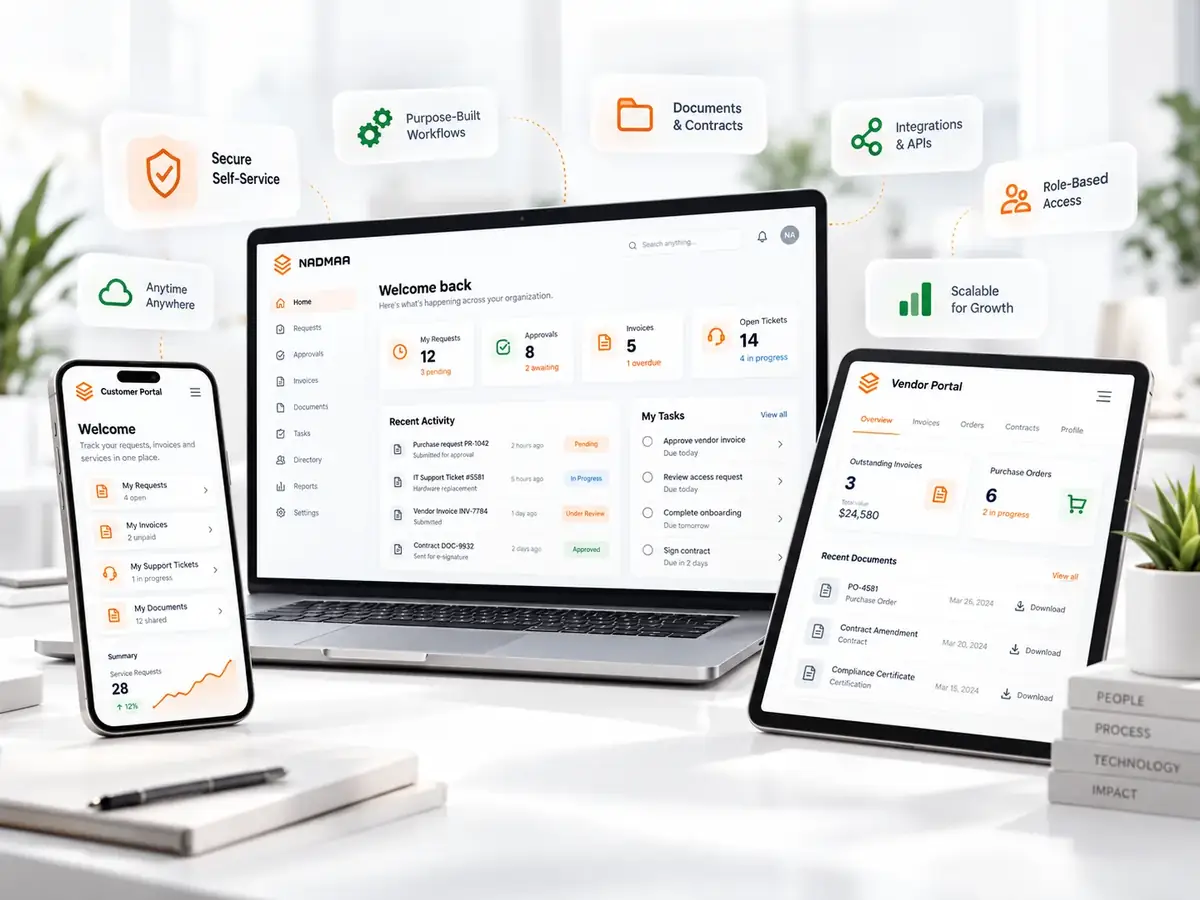
Nadmaa builds secure customer, vendor, and internal portals connected to the systems you already run—so people can access documents, track requests, take action, and move work forward without another email chase.

Customer portalsInternal toolsConnected platforms

What the engagement covers

One connected experience
Discovery and portal audit Users, permissions, recurring requests, documents, and source systems.

We start by identifying what clients keep asking for, what staff keep doing manually, and which records must stay accurate across the business.

Portal blueprint Client journeys, staff workflows, visibility rules, and action design.

The portal is shaped around what each role needs to see, download, approve, submit, or track without breaking operational control.

Build and integration Portal interface, backend actions, billing continuity, and workflow automation.

Receipts, invoices, applications, account records, and status updates stay connected to the systems that actually run the business.

Continuity Adoption, role refinement, analytics, and ongoing portal evolution.

After launch, we stay close to what clients use, where staff still compensate manually, and what the next operational improvement should be.

Best fit

Businesses that are answering too many routine account questions manually, need clients to self-serve invoices and documents, or want one portal layer connecting customers, finance, and operations.

Trusted by teams doing serious work

Lagos Business SchoolMint Microfinance BankKathairos SolutionsFejudam Maritime ServicesShoreline Support Consult

What we build

Self-service outside. Control inside.

Every portal is designed around the actions users need most and the operational rules your team cannot compromise.

Client self-service portal

Customers can log in to view invoices, receipts, balances, account documents, applications, statuses, and structured requests without waiting for someone internally to respond.

Internal operations workspace

Finance, operations, account teams, and managers get the control layer they need for approvals, account actions, document handling, and workflow movement behind the client-facing experience.

Permissions and document flow

Access is role-based and intentional, so different users see the right records, the right actions, and the right documents without exposing the wrong information.

System continuity

The portal sits on top of ERP, billing, CRM, or workflow systems in a way that preserves one source of truth rather than creating another disconnected interface layer.

When it pays off

Turn repetitive service into an experience customers value.

A portal is worth building when it removes high-volume friction for customers and gives your team a cleaner operating picture at the same time.

Clients expect transparency without having to ask twice

When customers need invoices, payment history, application status, or account documents, they increasingly expect to find them instantly rather than by chasing someone internally.

Support volume is being driven by repetitive account questions

Portals work best when a large share of inbound messages are predictable requests for visibility, files, status, or structured updates that the system could provide directly.

Finance and operations need the same account picture

Billing, approvals, documents, workflow states, and customer requests should sit in one connected operational picture instead of being split across inboxes, spreadsheets, and disconnected admin tools.

Trust improves when the portal matches reality

A portal becomes commercially valuable when what the client sees is current, actionable, and clearly tied to the real account lifecycle behind the scenes.

How we deliver

Premium at the surface. Serious underneath.

We design the customer experience and the internal workflow together, reducing integration risk and keeping every view grounded in reliable data.

Request-first portal thinking

We begin with the recurring questions, documents, approvals, and status checks that consume team time, because those are usually the clearest signals of what the portal must solve first.

Internal and external journeys designed together

The client journey and the staff workflow are shaped as one connected system, which prevents the portal from becoming a front-end promise disconnected from back-office reality.

Source-of-truth discipline

Invoices, account records, applications, and workflow states stay connected to the systems that govern them, which matters because stale or inconsistent portal data destroys trust quickly.

Premium feel with operational seriousness

The interface still needs calm UX, clear hierarchy, and credibility, but it is backed by permissions, auditability, and process logic that can survive real operating pressure.

Common questions

Business portal FAQs

What to establish before building customer or internal self-service.

What should a customer portal include?

Start with the highest-volume requests customers already make: account information, invoices, documents, payment history, application status, or structured requests. The portal should make those actions accurate and useful, not simply replicate an internal system.

Can a portal connect to our ERP or CRM?

Yes. A portal is most useful when it connects to the systems that govern customer records, billing, documents, and workflow states. This preserves a reliable source of truth and avoids creating another disconnected database.

Should we build an internal portal too?

Often. Customer self-service and staff operations need to work together. An internal workspace can give teams the permissions, approvals, and account controls needed to support the customer experience responsibly.

How do we choose the first portal release?

Choose a small set of actions that remove meaningful repeat work and can be supported by dependable data. A focused first release produces clearer adoption feedback and a safer base for future expansion.

Portal brief

Show us what people keep asking your team for.

We will help identify the strongest first release and the systems it needs to connect to.

No sales theatre. You will speak with the people who shape the work.