Version drift
People work from different copies and no one is certain which file is authoritative.
 Free 30-Min Review ↗
Replace spreadsheet-dependent operations
Turn critical Excel and Google Sheets workflows into controlled software without losing the business logic your team already relies on.
30 minutes · No presentation needed · Show us the spreadsheet as it works today.
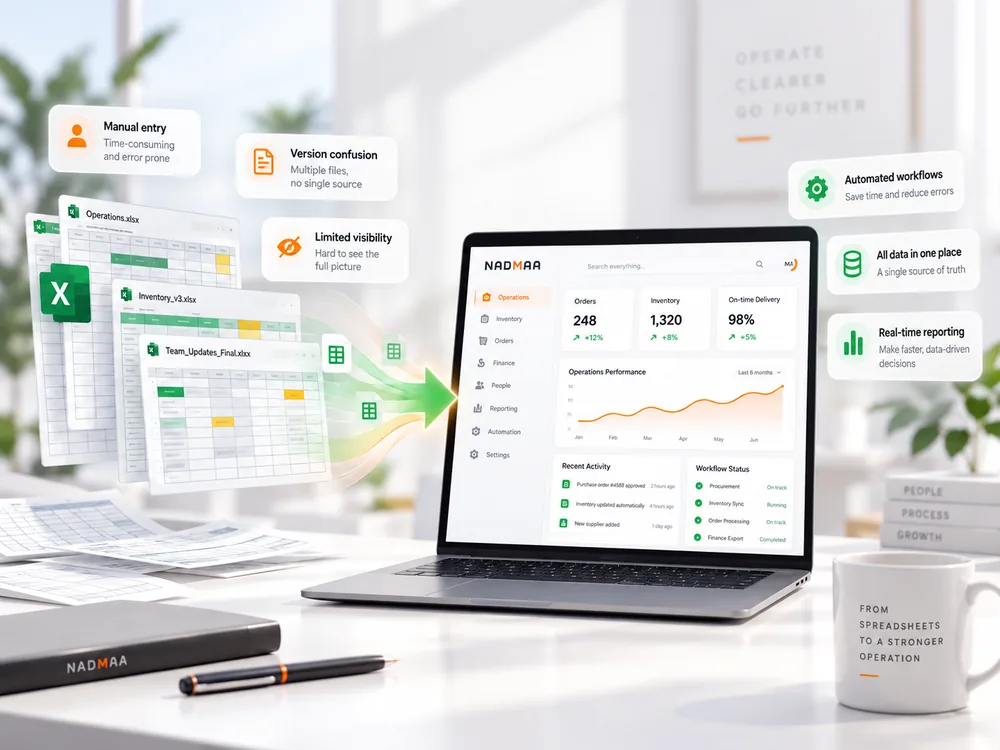
In plain language
We keep the useful business logic, then move it into a system that controls users, rules, status and history without version drift.
Recognize the pattern
The risk appears when one workbook becomes the source of truth, several people edit it, approvals happen in chat and nobody can easily reconstruct what changed.
People work from different copies and no one is certain which file is authoritative.
Pricing, approvals or calculations depend on formulas only a few people understand.
Rows become emails, chats and reminders because the spreadsheet cannot move work itself.
Sensitive or operational data is difficult to expose safely to the right roles.
The file contains data, but it cannot reliably show who owns the next action or what is overdue.
As records grow, management reporting becomes slower, more manual and less trustworthy.
Before → after
The aim is not to reproduce Excel on a web page. It is to keep the useful logic and remove the operational fragility.
People update rows, send emails, chase approvals and build reports around a file that was designed to calculate—not orchestrate a business.
The useful rules remain, but records have owners, states, permissions, automation, integrations and real-time visibility.
What you get
The new system should make ownership, validation, permissions and reporting explicit.
A structured interface for creating, updating and progressing records through the real business process.
Formulas, validation, approvals and decision logic translated into maintainable system behavior.
The right employees, managers, customers or vendors see only the information and actions relevant to them.
Dashboards and operational views built from the source workflow instead of manually reconstructed reports.
Questions buyers ask
What can be migrated, how formulas translate and when a configurable platform is enough.
Before you replace the spreadsheet
Use the Business Systems Blueprint if the workbook is only one part of a larger operating redesign.
Next step
We will map the logic inside it and show what a safer, easier-to-own replacement should look like.
Book a Systems Review ↗Free 30-minute review · No presentation needed · 30-minute Zoom call available