Executive Systems Assessment
What is working, what is failing and what deserves attention.
 Free 30-Min Fit Call ↗
Paid discovery · Business analysis · Functional consulting
Turn workflows, systems, spreadsheets and code into an approved future state and a build-ready handoff before implementation begins.
From CAD $4,500 · Fixed scope before work starts · No implementation lock-in · You own the Blueprint.
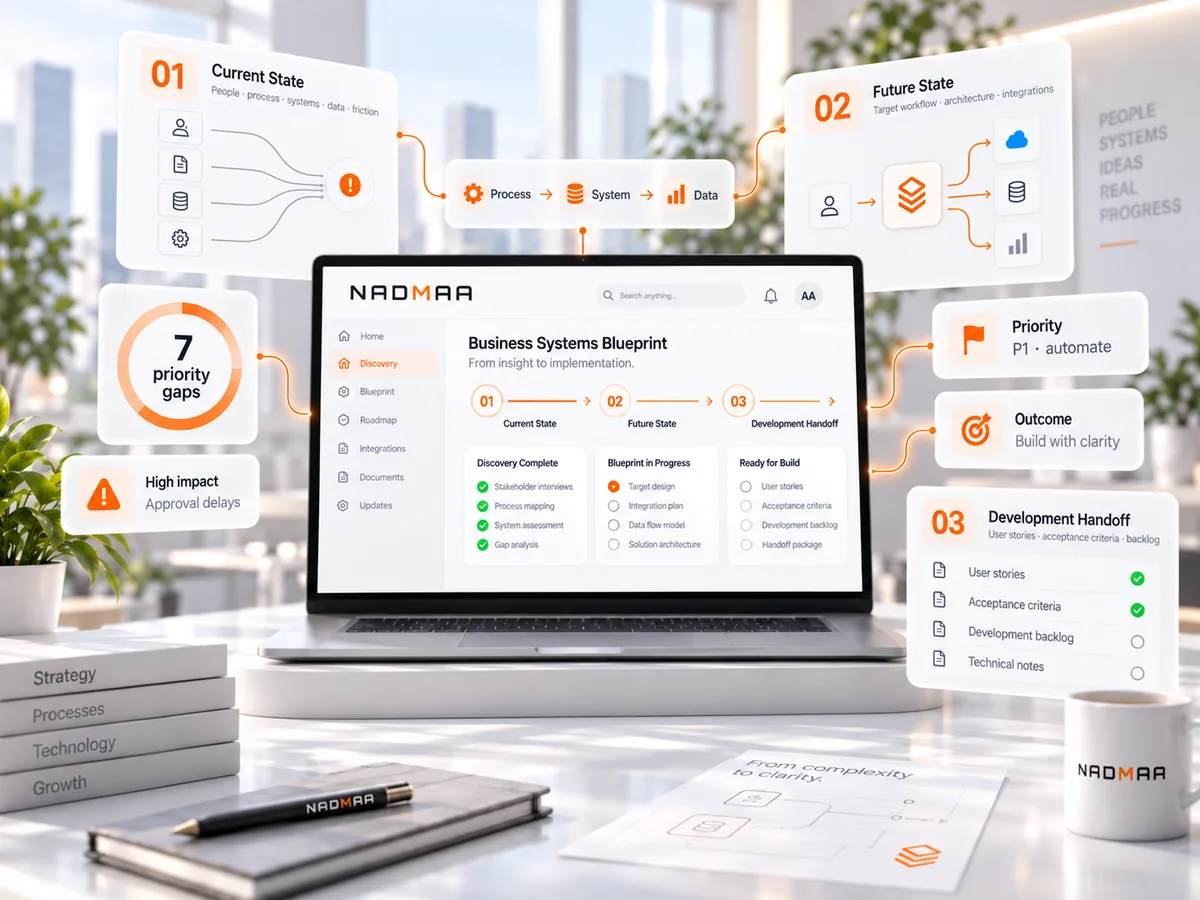
The gap we remove
Most expensive software mistakes begin before development starts: the business has one picture of the problem, the implementation team has another, and requirements are still changing after build work has begun.
Bring the evidence you already have: workflows, spreadsheets, ERP or CRM, documents, code or simply the operating problem. We turn it into an explicit current state before defining the build.
Example artifact library
Not every project needs every artifact. We select the documents that remove uncertainty for the specific change you are planning.
What is working, what is failing and what deserves attention.
The real AS-IS journey across people, systems and handoffs.
The TO-BE flow with ownership, controls and automation points.
Standard capability vs configuration, customization and integration.
The target system landscape, boundaries and major components.
Business, stakeholder, functional, non-functional and transition needs.
Development-ready behaviours with a shared definition of done.
Systems, triggers, APIs, data exchanged and failure handling.
Key entities, fields, cleanup, migration and reconciliation needs.
Who can view, create, approve, change and administer what.
P1/P2/P3 scope sequenced by value, dependency, effort and risk.
Phases, milestones, dependencies, budget bands and decision gates.
How the engagement works
AI can accelerate analysis, but the engagement is led as a functional consulting and business-analysis exercise. Outputs are reviewed against the business context before they become recommendations.
Agree the workflows, stakeholders, systems, evidence, access model and business outcomes.
Interviews plus review of workflows, spreadsheets, configuration, exports, code or data where relevant.
Challenge unnecessary steps, define ownership, controls, automation, integrations and target system behaviour.
Turn the approved future state into requirements, architecture, backlog, acceptance criteria and roadmap.
Controlled discovery
Discovery is designed around least-privilege, client-approved access. We can work from exports, sanitized workbooks, controlled environments, read-only databases, approved repositories or system access appropriate to the engagement.
Fixed-fee discovery
Starting prices are in Canadian dollars. We confirm a fixed scope and fee after the fit call so the boundaries are clear before work begins.
One bounded workflow, spreadsheet or operational problem with a small stakeholder group.
Primary system plus up to roughly three key workflows or departments, including a development handoff.
Multiple systems or departments with deeper integration, migration, architecture or codebase discovery.
Exact deliverables depend on the engagement boundary. Implementation is separate. If you choose Nadmaa to implement, the Blueprint becomes the agreed starting point—not unpaid discovery repeated inside the build.
Questions
No. That is one reason to do the Blueprint. We start from the operating problem and evidence, then determine whether the right answer is configuration, integration, automation, custom software, process redesign—or no new technology at all.
Yes. The engagement is platform-neutral and can work across a mixed environment. The scope determines whether we review exports, configuration, repositories, APIs, databases or controlled system access.
Yes. The Development Handoff Pack is specifically intended to reduce ambiguity for whichever team will build the solution.
No. The artifact library shows the range. A Focused Blueprint does not need the same depth as a multi-system transformation. We agree the exact deliverables before work begins.
No. AI-assisted tools may accelerate code, data or document analysis where appropriate, but the work is framed and reviewed as business analysis and functional consulting. Recommendations are tied back to process, users, controls, data and business outcomes.
You can stop, tender the work, hand it to your internal team, or ask Nadmaa to implement in phases. Either way, you retain the Blueprint and the implementation starts from an agreed scope.
Before the build
Show us how the operation works today. We will help turn it into a future-state design and a development-ready plan before implementation money starts moving.
Book a Systems Review ↗30-minute fit call · No implementation commitment · Fixed scope before paid discovery starts