Disconnected data sources
Critical information lives in separate applications, requiring staff to switch screens and copy data manually.
 Book a Systems Review ↗
API & Systems Integration
Connect accounting, CRM, ecommerce, payments, inventory and specialist applications so information moves once instead of being rebuilt at every handoff.
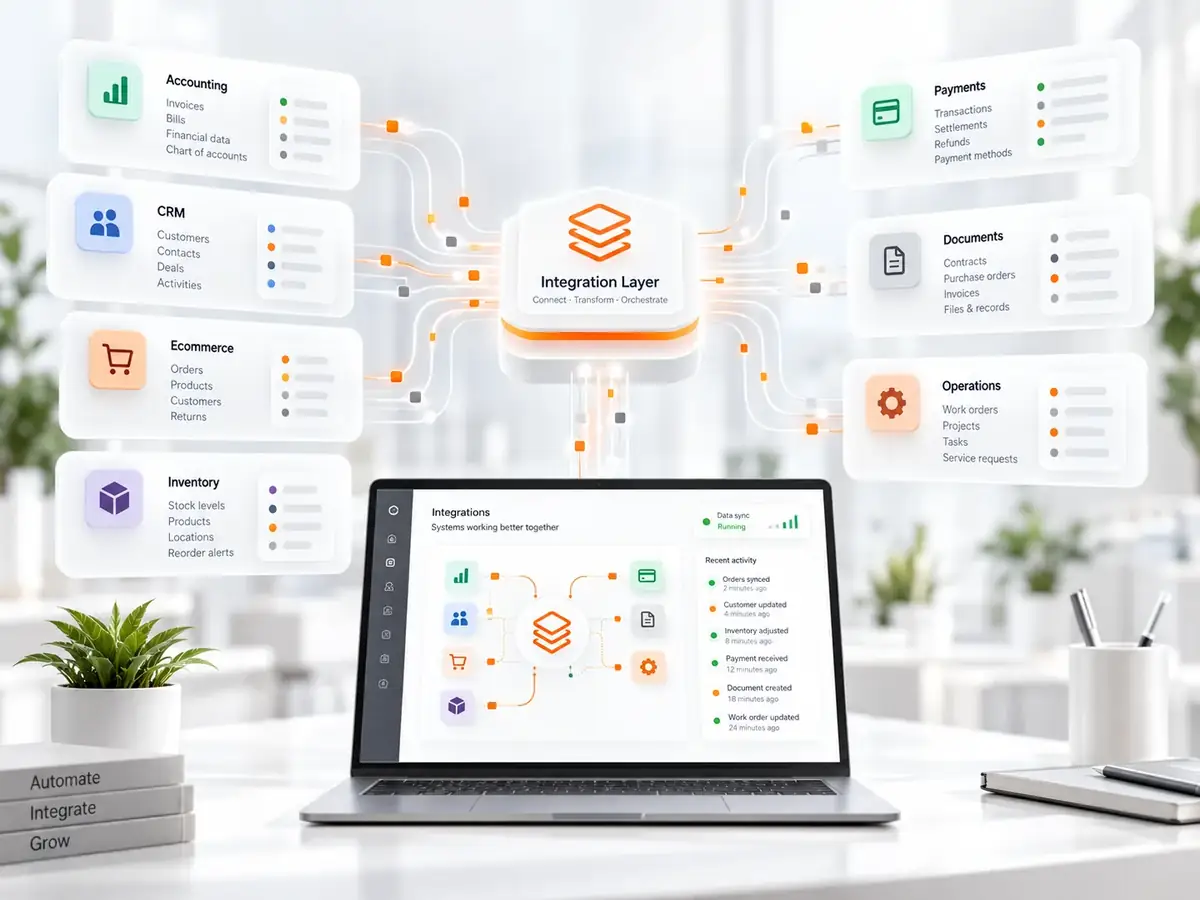
In practical terms
We define what each system owns, which data should move, when it should move and what happens when something fails. The connector comes after those rules are clear.
Where it helps
Critical information lives in separate applications, requiring staff to switch screens and copy data manually.
Repeated re‑keying of records introduces mistakes that propagate through downstream systems.
Different applications enforce divergent validation logic, leading to control gaps and rework.
Stakeholders cannot see up‑to‑date status because systems do not share information automatically.
What the engagement can produce
A visual diagram of workflows, handoffs, exceptions, and the data flows required between systems.
Formal definitions of endpoints, payload structures, authentication, and error handling.
Implemented integration layer—using Odoo, middleware platforms, or bespoke code—to move data as defined.
Test scripts, results, and documentation that enable your team to maintain and extend the integration.
The method
Interview stakeholders, capture current processes, and document rules, handoffs, and exceptions.
Select appropriate APIs, define data contracts, and outline middleware or custom‑code components.
Build or configure the required API endpoints, transformation logic, and error‑handling mechanisms.
Run functional and performance tests, deploy to production, and provide training and documentation.
Related thinking
Questions
Not necessarily. We first assess existing APIs and middleware options; custom development is used only when a suitable interface does not exist.
Our process defines data contracts, validation rules, error handling and test scenarios around the documented business process so each exchange can be checked before production use.
Yes. All connectors are built with modular specifications and documented handover materials, allowing your team or a future vendor to add endpoints or modify logic without re‑architecting the whole solution.
Calgary · Canada · North America
We will identify the systems, records and rules involved, then design the simplest reliable way for information to move between them.
Book a Systems Review ↗